When we evaluate a patient with dysphagia, it is very easy to get tunnel vision for the swallow. We focus so much on that one piece of the puzzle that all the other pieces around it begin to blur.
After all, evaluating and treating the swallow is what we do best. We examine the anatomy and physiology, ensure pharyngeal clearance, monitor for penetration or aspiration during instrumental swallowing evaluations, and make recommendations regarding diet textures and compensatory strategies.
Yet when looking closely at real-world patient outcomes, the single strongest predictor of aspiration pneumonia is not whether a patient penetrates or aspirates on an instrumental swallow study.
It is whether someone else has to feed them.
In fact, the risk for aspiration, by itself, isn’t a significant risk factor at all. Is it necessary? Yes. Is it sufficient? Nope.
The ability to feed oneself safely is key not only to adequate nutrition and hydration through oral intake, but also to airway protection and overall health-related quality of life.
How Important Is Self-Feeding in Dysphagia Management?
In functional assessment and geriatric medicine, self-feeding occupies a unique position: it is universally recognized as a "late-loss" ADL.
Dorothy Dunlop and colleagues (1997) tracked functional decline over six years across community-dwelling older adults. They found that walking fails first, followed by bathing, transferring, dressing, toileting, and finally… Feeding.
When we think about physical decline in old age, we naturally assume that basic daily tasks all fail around the same time. But the data reveals something else entirely: Decades after mobility and personal grooming have faded, the ability to feed oneself remains completely intact, typically holding strong until our 100th birthday.

Because eating is the final functional loss, an individual who can no longer feed themselves has almost certainly lost the ability to ambulate independently, use the toilet, transfer, and maintain their personal hygiene.
In Susan Langmore and colleagues' (1998) landmark prospective study on the predictors of aspiration pneumonia, this functional collapse showed its clinical teeth…
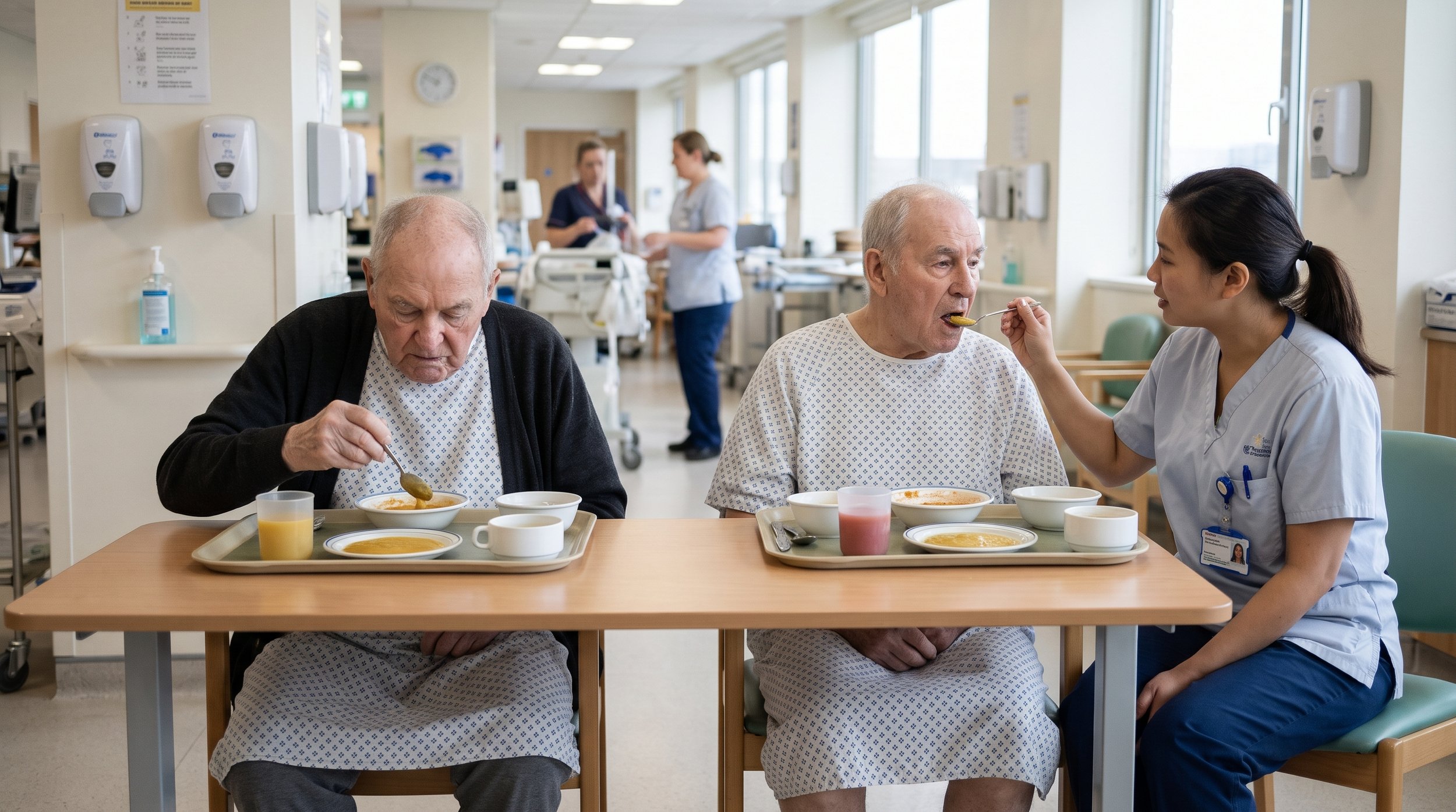
Picture two nursing home residents sitting at the same table. Both have swallowing difficulties, but one can still feed himself, while the second requires a caregiver to spoon-feed every bite. Even though they are eating the exact same meal, the second patient is facing a vastly different risk of aspiration. This is because relying on someone else to hold the spoon makes them 20 times more likely to develop aspiration pneumonia.
The Barriers, Risk Factors, and Mechanism of Harm
Why does losing self-feeding independence pose such a massive clinical hazard?
When a person feeds themselves, their sensory, neurological, and motor systems operate in a coordinated feedback loop. They control the bolus's pace and volume, as well as the exact moment food enters the oral cavity. This gives them more control over their breathing and swallowing coordination.
When an individual becomes dependent, there are three main risk factors we need to consider:
Pacing: In busy healthcare environments, staff and caregivers are often rushed and under heavy time constraints. They may inadvertently feed a resident too fast or offer bites and sips that are too large. This easily overwhelms a delayed pharyngeal swallow or weak bolus propulsion, loading the pharynx with food before the airway can protect itself.
Readiness: In moderate-to-severe dementia, individuals frequently experience attentional drift, fluctuating alertness, or oral apraxia. An outside feeder cannot feel the patient's internal readiness, leading to food placement when the patient is lethargic, unengaged, or about to inhale.
Oral Hygiene: Because self-feeding is a late-loss ADL, individuals dependent on feeding are essentially always dependent for personal hygiene and oral care as well. Langmore and colleagues found that dependence for oral care and the presence of decayed teeth were also major independent predictors of pneumonia. When a caregiver must feed a patient who cannot brush their own teeth, each oversized, unpaced bolus carries a potential inoculum of pathogenic oral bacteria directly into an unprotected airway.
It’s Not ALL About Swallowing
Preserving or regaining self-feeding is not only about pulmonary safety—it is directly tied to human dignity and psychosocial well-being.
Chan et al. (2015) evaluated the link between ADL independence and health-related quality of life (HRQL) in long-term care residents with dementia using the Quality of Life-Alzheimer's Disease (QOL-AD) scale. They found that greater independence in basic ADLs was significantly associated with higher HRQL scores.
Specifically, performance on tasks like eating, dressing, and personal hygiene showed robust, statistically significant correlations with quality of life.
When individuals are stripped of control over how and when they eat, their autonomy shrinks, mealtime enjoyment erodes, and their risk for functional decline accelerates. Treating self-feeding as an active therapeutic target protects both the lungs and the person.
What the Speech-Language Pathologist Can Do to Help
As SLPs, our job does not stop at analyzing the modified barium swallow study or flexible endoscopic evaluation of swallowing. If dependence for feeding carries an odds ratio of nearly 20 for pneumonia, managing this mealtime dynamic is our clinical responsibility.
Here are four practical approaches to SLP intervention…
Preserve Autonomy: Collaborate closely with Occupational Therapy to assess the physical and visual barriers to eating. Introduce adaptive utensils, weighted cutlery, scoop plates, or high-contrast table settings. Even if a patient cannot manage an entire meal independently, support partial independence. This can include hand-over-hand guidance, verbal cues from the patient to signal readiness, or allowing them to self-feed finger foods and liquids while staff assists with more complex textures.
Feeding Assistance: Establish structured feeder education programs within facilities and home settings (akin to the "Silver Spoons" models cited by Langmore and colleagues). Train nursing assistants, feeding aides, and family members to eliminate rapid feeding, large volumes, and other unsafe practices. Emphasize small bolus sizes, 1:1 attention, feeding at eye level, matching the patient’s natural cadence, and waiting for dry swallows or complete pharyngeal clearance before presenting the next bite.
Oral Care: Recognize that a dependent feeder is almost certainly an individual with dependent oral hygiene. Incorporate systematic oral decontamination into the dysphagia care plan. Oral care prior to and following meals drastically reduces the pathogenic bacterial load in the oral cavity, ensuring that any incidental or microaspiration does not deliver a lethal bacterial load to the pulmonary beds.
Other Strategies: Ensure meals occur in upright, supported seated postures—out of bed whenever possible—to maximize airway protection, self-reach mechanics, and pulmonary clearance. Reduce overstimulating background noise in dining areas to help patients with moderate-to-severe cognitive impairment focus on the sensorimotor sequence of eating.
Dysphagia management cannot be reduced to whether the vocal cords close properly during a swallow. True airway protection requires seeing the patient in context: supporting their independence, training the hands that feed them, cleaning the oral cavity, and treating the act of eating with an attention to quality of life and the holistic care it demands.